|
Tue7 Apr11:10am(15 mins)
|
Where:
JMS Breakout Room (Room 641)
Session:
Speaker:
|

Horizontal transfer of transposable elements (HTT) is increasingly recognised as a significant force in eukaryotic genome evolution, particularly in ecological contexts that promote intimate biological interactions. The parasitic flatworm Schistosoma mansoni, the causative agent of intestinal schistosomiasis, possesses a transposable element (TE)-rich genome and a complex life cycle involving prolonged association with molluscan intermediate hosts and aquatic free-living stages—conditions theoretically conducive to HTT.
Leveraging a chromosome-scale genome assembly for S. mansoni and recently published high-quality genomes of Schistosoma spp. and panpulmonate snails, we systematically searched for evidence of horizontal TE transfer. Using a relaxed BLASTN strategy and manual TE curation, we identified two LINE-RTE elements, Perere-3 and Sr3, as strong HTT candidates.
Within the S. mansoni genome, Perere-3 and Sr3 together comprise approximately 6% of the genome and represent two of its most abundant TEs. Both elements encode intact L1 endonuclease and reverse transcriptase domains, segregate into distinct phylogenetic clusters, and display evidence of recent activity, including numerous insertions with zero terminal branch length, consistent with ongoing or very recent transposition.
Strikingly, near full-length Perere-3/Sr3-like elements were identified in multiple planorbid snail genomes, including known intermediate hosts. These elements are absent from other sampled trematodes and from the human definitive host. The deep evolutionary divergence between molluscs and schistosomes (~600 million years), combined with high sequence similarity and multiple full-length copies in both groups, is incompatible with vertical inheritance alone. Phylogenetic analyses reveal clustering of Schistosoma elements within a broader diversity of molluscan sequences, supporting a model in which Perere-3/Sr3 were horizontally acquired from an ancestral snail host prior to diversification of the Schistosoma genus.
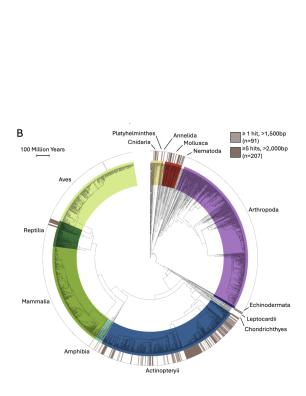
Extending our analysis to over 2,000 high-quality metazoan genomes revealed a patchy and discontinuous distribution of Perere-3/Sr3-like sequences across reptiles, fish, molluscs, amphibians, and selected marine invertebrates. Phylogenetic incongruence between TE trees and species trees further supports multiple horizontal transfer events beyond the Schistosoma–mollusc system.
Together, these findings provide robust genomic evidence for horizontal transfer of LINE-RTE elements in a medically important parasite and suggest that aquatic environments and host–parasite interactions may facilitate broader dissemination of mobile genetic elements across metazoa. Given previous refutations of proposed gene transfers in schistosomes, this study represents one of the most comprehensive and methodologically rigorous demonstrations.