BSP Spring Meeting 2026 in Collaboration with Elsevier
Schedule : Back to Yassar Kadoom
Poster
122

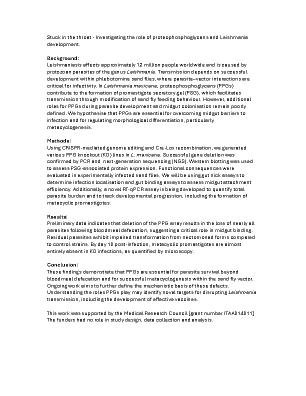
Stuck in the throat - Investigating the role of proteophosphoglycans and Leishmania development.

Authors

Y Kadoom1; JD Sunter2; M Rogers11 London School of Hygiene and Tropical Medicine, UK;  2 Department of Biological and Medical Sciences, Oxford Brookes University, Oxford, UK

Discussion

Background: Leishmaniasis affects approximately 12 million people worldwide and is caused by protozoan parasites of the genus Leishmania. Transmission depends on successful development within phlebotomine sand flies, where parasite–vector interactions are critical for infectivity. In Leishmania mexicana, proteophosphoglycans (PPGs) contribute to the formation of promastigote secretory gel (PSG), which facilitates transmission through modification of sand fly feeding behaviour. However, additional roles for PPGs during parasite development and midgut colonisation remain poorly defined. We hypothesise that PPGs are essential for overcoming midgut barriers to infection and for regulating morphological differentiation, particularly metacyclogenesis.

 Methods:

Using CRISPR-mediated genome editing and Cre-Lox recombination, we generated various PPG knockout (KO) lines in L. mexicana. Successful gene deletion was confirmed by PCR and  next-generation sequencing (NGS). Western blotting was used to assess PSG-associated protein expression. Functional consequences were evaluated in experimentally infected sand flies. We will be using gut nick assays to determine infection localisation and gut binding assays to assess midgut attachment efficiency. Additionally, a novel RT-qPCR assay is being developed to quantify total parasite burden and to track developmental progression, including the formation of metacyclic promastigotes.


Results: Preliminary data indicates that deletion of the PPG array results in the loss of nearly all parasites following bloodmeal defecation, suggesting a critical role in midgut binding. Residual parasites exhibit impaired transformation from nectomonad forms compared to control strains. By day 10 post-infection, metacyclic promastigotes are almost entirely absent in KO infections, as quantified by microscopy.

 Conclusion:

These findings demonstrate that PPGs are essential for parasite survival beyond bloodmeal defecation and for successful metacyclogenesis within the sand fly vector. Ongoing work aims to further define the mechanistic basis of these defects. Understanding the roles PPGs play may identify novel targets for disrupting Leishmania transmission, including the development of effective vaccines.

Hosted By

British Society for Parasitology (BSP)

We are science based Charitable Incorporated Organisation

Get the App

Get this event information on your mobile by
going to the Apple or Google Store and search for 'myEventflo'
iPhone App
Android App
www.myeventflo.com/2554