Authors
S Khaskheli1; S Naz1; AA Ujjan1; 1 University of Sindh , PakistanDiscussion
Feathers are characterized with a complex micro-ecosystem that supports varied communities of arthropods and microorganisms. Feather mites (Astigmata) are permanent ectosymbionts that inhabit the surface of feathers, feeding primarily on preen gland oils, organic debris, and fungal spores.
The Accridotheres tristis (Common Myna) is a widespread passerine bird in Pakistan, but there is limited information exists regarding its plumage associated microfauna and microflora. At present, it is the first study on common myna mites of family Xolalgidae in association with its feather fungus of family Chaetomiaceae in the country.
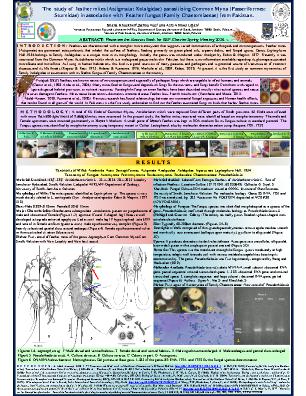
A total of 56 birds were captured from different parts of Sindh province, in which 43 birds were found infested with mites. More than 500 specimens of Xolalgid mites were recovered by examined the feathers under stereomicroscope. Mites were preserved in 80% ethanol, cleared in lactic acid and mounted permanently in Hoyer’s medium. The mite mounts were examined for identification using photography with Nikon digital camera, illustrations with drawing tube attachment fixed in light microscope. For fungal association, small fragments of myna feathers were surface-sterilized and inoculated onto Sabouraud Dextrose Agar (SDA) and Potato Dextrose Agar (PDA); plates were incubated at 25-28°C for 10-14 days. The fungal culture was then mounted temporarily in Lectophenol cotton blue for microscopic examination, and molecular analysis.
In the present study, the feather mites recovered from A. tristis were identified on the basis of morpho-taxonomy, belongs to the genus Leptosphyra Hull, 1934 (family Xolalgidae). The male and female specimens were described in detail, reported for the first time from Pakistan. Morphology, morphometery and comparison of the present species with other known species of this genus were also provided. The associated fungus species was identified by its morphology as well as molecular characterization using the gene ITS1 and ITS2, as Pseudothielavia arxii (Stchigel and Guarro) with new association and new country records to science.