Authors
AP Jackson2; R Young1; M Whitehead3; P Steketee1; AC Darby3; LJ Morrison1; 1 The Roslin Institute, University of Edinburgh, UK; 2 Institute of Infection, Veterinary and Ecological Sciences, University of Liverpool, UK; 3 Centre for Genomic Research, University of Liverpool, UKDiscussion
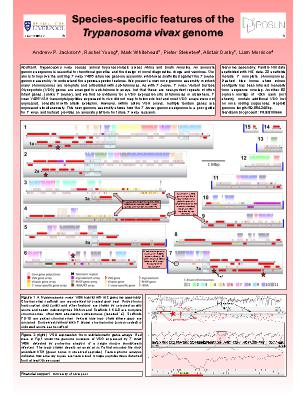
Trypanosoma vivax causes animal trypanosomiasis across Africa and South America. An accurate genome sequence is essential for functional genetics and the design of novel diagnostics, drugs and vaccines. Our aim is to improve the existing T. vivax Y486 reference genome assembly, which was scaffolded against the T. brucei genome assembly, to understand the species-specific features. We present a new core genome assembly in which many chromosomes are complete and articulated with sub-telomeres. As with T. brucei, T. vivax Variant Surface Glycoprotein (VSG) genes are arranged in sub-telomeric arrays, but that these are near-perfect repeats of often intact genes, (unlike T. brucei), and we find no evidence for a VSG expression site at telomeres or elsewhere. T. vivax Y486 VSG transcripts/peptides expressed in vivo did not map to telomeric loci and most VSG arrays were not expressed, consistent with allelic exclusion. However, within active VSG arrays, multiple tandem genes are expressed simultaneously. This new genome assembly shows how the T. brucei genome sequence is a poor guide for T. vivax and instead provides an accurate platform for future T. vivax research.