Authors
J Andersson1; J Fredlund1; E Tydén1; 1 Swedish University of Agricultural Sciences, SwedenDiscussion
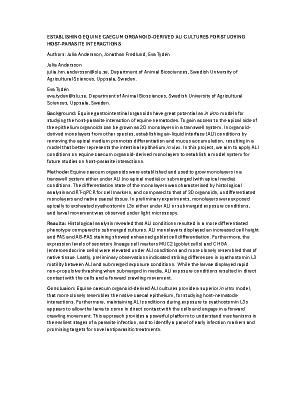
Background: Equine gastrointestinal organoids have great potential as in vitro models for studying the host-parasite interaction of equine nematodes. To gain access to the apical side of the epithelium organoids can be grown as 2D monolayers in a transwell system. In organoid-derived monolayers from other species, establishing air-liquid interface (ALI) conditions by removing the apical medium promotes differentiation and mucus accumulation, resulting in a model that better represents the intestinal epithelium in vivo. In this project, we aim to apply ALI conditions on equine caecum organoid-derived monolayers to establish a model system for future studies on host-parasite interactions.
Methods: Equine caecum organoids were established and used to grow monolayers in a transwell system either under ALI (no apical media) or submerged (with apical media) conditions. The differentiation state of the monolayers was characterised by histological analysis and RT-qPCR for cell markers, and compared to that of 3D organoids, undifferentiated monolayers and native caecal tissue. In preliminary experiments, monolayers were exposed apically to exsheated cyathostomin L3s either under ALI or submerged exposure conditions, and larval movement was observed under light microscopy.
Results: Histological analysis revealed that ALI conditions resulted in a more differentiated phenotype compared to submerged cultures. ALI monolayers displayed an increased cell height and PAS and AB-PAS staining showed enhanced goblet cell differentiation. Furthermore, the expression levels of secretory lineage cell markers MUC2 (goblet cells) and CHGA (enteroendocrine cells) were elevated under ALI conditions and more closely resembled that of native tissue. Lastly, preliminary observations indicated striking differences in cyathostomin L3 motility between ALI and submerged exposure conditions. While the larvae displayed rapid non-propulsive thrashing when submerged in media, ALI exposure conditions resulted in direct contact with the cells and a forward crawling movement.
Conclusion: Equine caecum organoid-derived ALI cultures provide a superior in vitro model, that more closely resembles the native caecal epithelium, for studying host-nematode interactions. Furthermore, maintaining ALI conditions during exposure to cyathostomin L3s appears to allow the larva to come in direct contact with the cells and engage in a forward crawling movement. This approach provides a powerful platform to understand mechanisms in the earliest stages of a parasite infection, and to identify a panel of early infection markers and promising targets for novel antiparasitic treatments.