|
Tue7 Apr11:10am(15 mins)
|
Where:
JMS Breakout Room (Room 745)
Session:
Speaker:
|

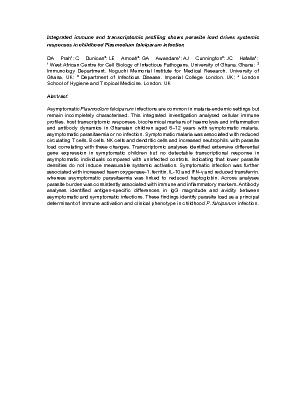
Asymptomatic Plasmodium falciparum infections are common in malaria-endemic settings but remain incompletely characterised. This integrated investigation analysed cellular immune profiles, host transcriptomic responses, biochemical markers of haemolysis and inflammation and antibody dynamics in Ghanaian children aged 6–12 years with symptomatic malaria, asymptomatic parasitaemia or no infection. Symptomatic malaria was associated with reduced circulating T cells, B cells, NK cells and dendritic cells and increased neutrophils, with parasite load correlating with these changes. Transcriptomic analyses identified extensive differential gene expression in symptomatic children but no detectable transcriptional response in asymptomatic individuals compared with uninfected controls, indicating that lower parasite densities do not induce measurable systemic activation. Symptomatic infection was further associated with increased haem oxygenase-1, ferritin, IL-10 and IFN-γ and reduced transferrin, whereas asymptomatic parasitaemia was linked to reduced haptoglobin. Across analyses parasite burden was consistently associated with immune and inflammatory markers. Antibody analyses identified antigen-specific differences in IgG magnitude and avidity between asymptomatic and symptomatic infections. These findings identify parasite load as a principal determinant of immune activation and clinical phenotype in childhood P. falciparum infection.