|
Wed8 Apr04:10pm(15 mins)
|
Where:
JMS Breakout Room (Room 641)
Speaker:
|
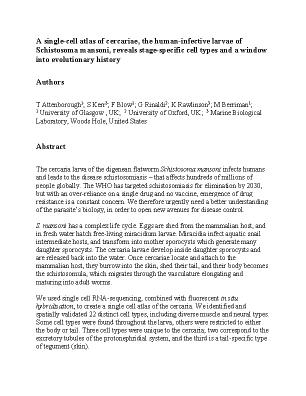
The cercaria larva of the digenean flatworm Schistosoma mansoni infects humans and leads to the disease schistosomiasis – that affects hundreds of millions of people globally. The WHO has targeted schistosomiasis for elimination by 2030, but with an over-reliance on a single drug and no vaccine, emergence of drug resistance is a constant concern. We therefore urgently need a better understanding of the parasite’s biology, in order to open new avenues for disease control.
S. mansoni has a complex life cycle. Eggs are shed from the mammalian host, and in fresh water hatch free-living miracidium larvae. Miracidia infect aquatic snail intermediate hosts, and transform into mother sporocysts which generate many daughter sporocysts. The cercaria larvae develop inside daughter sporocysts and are released back into the water. Once cercariae locate and attach to the mammalian host, they burrow into the skin, shed their tail, and their body becomes the schistosomula, which migrates through the vasculature elongating and maturing into adult worms.
We used single cell RNA-sequencing, combined with fluorescent in situ hybridisation, to create a single cell atlas of the cercaria. We identified and spatially validated 22 distinct cell types, including diverse muscle and neural types. Some cell types were found throughout the larva, others were restricted to either the body or tail. Three cell types were unique to the cercaria; two correspond to the excretory tubules of the protonephridial system, and the third is a tail-specific type of tegument (skin).
We estimated the relative transcriptomic ‘age’ of each cell cluster using a bioinformatic approach to approximate the ‘age’ of genes in our profiled transcriptomes based on their phyletic distributions. Stem cells are the ‘evolutionarily oldest’ cluster, whereas within tegument tissues, tail-specific cell types are the ‘evolutionarily youngest’, This suggests that the tail-specific cell types emerged with the evolution of the tail, and the addition of the free-swimming cercarial stage in the ancestral digenean life cycle.
To better understand the transition from free-swimming larvae to the first intramammalian parasitic stage, we compared the transcriptomic profiles of cercariae and schistosomula 48 hours after transformation using scRNA-seq. It has previously been suggested that cercariae are ‘pre-loaded’ with transcripts needed for intramammalian development. Using RNA velocity, we identified specific genes where changes in expression dynamics were detected during cercaria-schistosomulum transition. These findings shed new light on the on transcriptional activity of body cell types in these stages.
We have characterised the human-infective cercaria stage of S. mansoni at the single cell level. Moreover, we contributed to the understanding of the complex morphological and transcriptomic changes underlying the transition from the free-living infective stage to the first intramammalian parasitic stage. We hope this knowledge can contribute to developing strategies to combat schistosomiasis and reduce global disease burden.