|
Tue7 Apr10:45am(25 mins)
|
Where:
JMS Breakout Room (Room 745)
Session:
Keynote Speaker:
|

Background:
Schistosomiasis remains a significant public health challenge in endemic regions, leading to substantial morbidity, in the absence of a functional vaccine until date. While regular mass drug administration (MDA) of praziquantel (PZQ) is a cornerstone of schistosomiasis control programs in endemic areas, emerging evidence suggests that its benefits, not fully harnessed, may extend beyond mere parasite killing, orchestrating a chemotherapeutically-induced immunity in treated hosts. We aimed to address this possibility.
Methods:
We examined schistosomiasis in school-aged children from affected areas who received different cumulative numbers of annual PZQ treatments. We monitored reinfection rates and health effects, like anaemia, cognitive impairment and liver fibrosis. A mouse model was also used to analyse, beyond association, the likelihood of causality in how the numbers of infection-PZQ treatment cycles might affect susceptibility to reinfection, pathologies and immune responses.
Results:
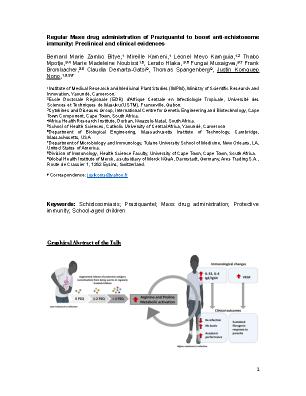
Analysis of data and samples from SAC showed that regular use of PZQ in endemic area activated more rapidly arginine/proline metabolism and increased protective IgE levels and type-2 cytokines in these SAC. This lowered the chance of subsequent high parasite levels (AOR = 0.16) and improved haemoglobin (AOR = 2.58) and academic performance (AOR = 2.39). Similarly, in the mouse model, repeated cycle of infection/treatments boosted immune responsiveness, particularly of the type-2 arm (parasite-directed IgE and IgG1, Arginase-1) and translated into increased resistance to reinfection.
Conclusion
The study shows that regular treatment with PZQ can improve protective immune responses in children from schistosomiasis-endemic areas, reducing the risk of reinfection and associated sequelae.