|
Poster
9 |
Where:
JMS Breakout Room (Room 745)
Speaker:
|

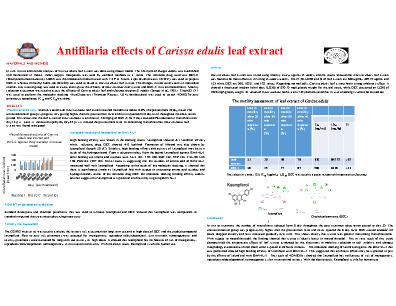
This study was designed to screen the invivo, invitro, and insilico antifilarial effect of Carissa edulis leaf extract on Brugia malayi. Carissa edulis fresh leaveswere collected from fields in Ebonyi State University Abakaliki .The life cycle of Brugia malayi was established and maintained in mouse. Aedes aegypti mosquitoes was used as a vector. Chem3D 15.1 was used to perform the molecular docking. ADME/Toxicity parameters compliance was screened using MetaDiscovery (Thomson Reuters, USA) database tool to evaluate and predict the compliance of human metabolism. The study recorded significant and time/dose dependent antifilarial effects of the extract In the invivo study, animals treated with extract has low microfilara (below 40%) the pretreatment (0 day) level. Invitro assay showed that Carissa edulis leaf extract had a strong inhibitory effect. High binding affinity was shown in the docking results. kaempferol (-6.1 kcal/mol) showed similar affinity to that of reference drug, DEC (-4.0 kcal/mol). The result of the ADME showed that kaempferol was comparable to standard range and that there was no predictive hepatotoxicity. It showed that kaempferol has no features of risk of reproductive toxicity, mutagenicity, skin irritation or tumorogenicity. This shows that kaempferol is safe for human use.