|
Wed8 Apr09:40am(15 mins)
|
Where:
JMS Breakout Room (Room 745)
Session:
Speaker:
|
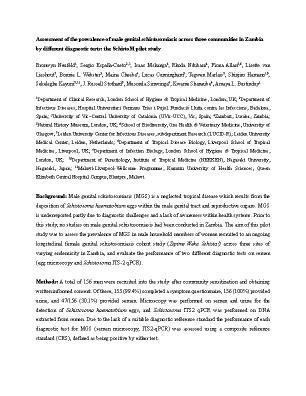
Background: Male genital schistosomiasis (MGS) is a neglected tropical disease which results from the deposition of Schistosoma haematobium eggs within the male genital tract and reproductive organs. MGS is underreported partly due to diagnostic challenges and a lack of awareness within health systems. Prior to this study, no studies on male genital schistosomiasis had been conducted in Zambia. The aim of this pilot study was to assess the prevalence of MGS in male household members of women recruited to an ongoing longitudinal female genital schistosomiasis cohort study (Zipime Weka Schista!) across three sites of varying endemicity in Zambia, and evaluate the performance of two different diagnostic tests on semen (egg microscopy and Schistosoma ITS-2 qPCR).
Methods: A total of 156 men were recruited into the study after community sensitization and obtaining written informed consent. Of these, 155 (99.4%) completed a symptom questionnaire, 156 (100%) provided urine, and 47/156 (30.1%) provided semen. Microscopy was performed on semen and urine for the detection of Schistosoma haematobium eggs, and Schistosoma ITS2 qPCR was performed on DNA extracted from semen. Due to the lack of a suitable diagnostic reference standard the performance of each diagnostic test for MGS (semen microscopy, ITS2-qPCR) was assessed using a composite reference standard (CRS), defined as being positive by either test.
Results: The overall prevalence of MGS by either diagnostic across all sites was 12.8% (6.4% [3/47] by semen microscopy and 12.8% [6/47] by semen qPCR). Overall prevalence was highest in Site 3 (27.3%, 3/11), compared to Site 1 (9.1%, 2/22) and Site 2 (7.1%, 1/14). Against the CRS, the sensitivity of semen microscopy was 50.0% (95% CI: 11.8-88.2) and the sensitivity of semen qPCR was 100.0% (95% CI: 54.1-100.0).
Conclusions: This pilot study presents the first data on MGS in Zambia and is the first evaluation of MGS diagnostics using a composite reference standard. We show that MGS is prevalent in Zambia and that qPCR on semen is a highly sensitive diagnostic method compared to microscopy. Further optimization of diagnostic tools for MGS, particularly for use in resource-constrained settings, is needed to facilitate enhanced case detection.