|
Tue7 Apr12:13pm(3 mins)
|
Where:
JMS Main Room (438AB)
Session:
Speaker:
|
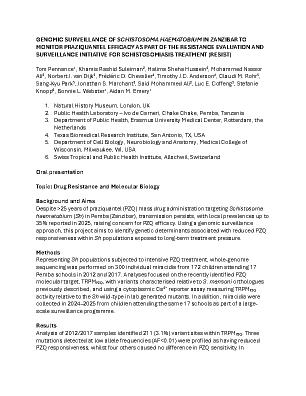
Despite >25 years of praziquantel (PZQ) mass drug administration targeting Schistosoma haematobium (Sh) in Pemba (Zanzibar), transmission persists, with local prevalences up to 35% reported in 2025, raising concern for PZQ efficacy. Using a genomic surveillance approach, this project aims to identify genetic determinants associated with reduced PZQ responsiveness within Sh populations exposed to long-term treatment pressure. Representing Sh populations subjected to intensive PZQ treatment, whole-genome sequencing was performed on 300 individual miracidia from 172 children attending 17 Pemba schools in 2012 and 2017. Analyses focused on the recently identified PZQ molecular target, TRPMPZQ, with variants characterised relative to S. mansoni orthologues previously described, and using a cytoplasmic Ca2+ reporter assay measuring TRPMPZQ activity relative to the Sh wild-type in lab generated mutants. In addition, miracidia were collected in 2024–2025 from children attending the same 17 schools as part of a large-scale surveillance programme. Analysis of 2012/2017 samples identified 211 (3.1%) variant sites within TRPMPZQ. Three mutations detected at low allele frequencies (AF<0.01) were profiled as having reduced PZQ responsiveness, whilst four others caused no difference in PZQ sensitivity. In 2024/2025, 12,598 miracidia were collected from 428 children, including 14 individuals who were positive post-PZQ treatment. This is the first large-scale spatiotemporal genomic surveillance of Sh in relation to PZQ treatment. Allele frequency shifts of TRPMPZQ variants attributed with decreased PZQ sensitivity in 2012/2017 Sh populations will be monitored in 2025-2025. Analysis of 2024–2025 samples will enable assessment of PZQ-mediated selection and inform control and elimination strategies.