Authors
O Okeremi1; C Souza1; O Borden1; G Chami2; P Loke1; 1 Laboratory of Parasitic Diseases, National Institutes of Health, NIAID, United States; 2 University of Oxford, Big Data Institute, UKDiscussion
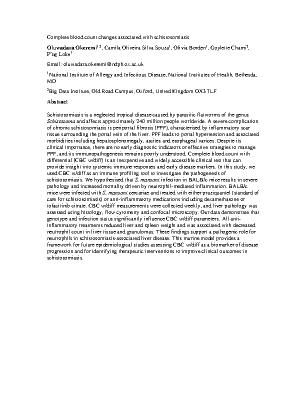
Schistosomiasis is a neglected tropical disease caused by parasitic flatworms of the genus Schistosoma and affects approximately 240 million people worldwide. A severe complication of chronic schistosomiasis is periportal fibrosis (PPF), characterised by inflammatory scar tissue surrounding the portal vein of the liver. PPF leads to portal hypertension and associated morbidities including hepatosplenomegaly, ascites and esophageal varices. Despite its clinical importance, there are no early diagnostic indicators or effective strategies to manage PPF, and its immunopathogenesis remains poorly understood. Complete blood count with differential (CBC w/diff) is an inexpensive and widely accessible clinical test that can provide insight into systemic immune responses and early disease markers. In this study, we used CBC w/diff as an immune profiling tool to investigate the pathogenesis of schistosomiasis. We hypothesised that S. mansoni infection in BALB/c mice results in severe pathology and increased mortality driven by neutrophil-mediated inflammation. BALB/c mice were infected with S. mansoni cercariae and treated with either praziquantel (standard of care for schistosomiasis) or anti-inflammatory medications including dexamethasone or tofacitinib citrate. CBC w/diff measurements were collected weekly, and liver pathology was assessed using histology, flow cytometry and confocal microscopy. Our data demonstrate that genotype and infection status significantly influence CBC w/diff parameters. All anti-inflammatory treatments reduced liver and spleen weight and was associated with decreased neutrophil count in liver tissue and granulomas. These findings support a pathogenic role for neutrophils in schistosomiasis-associated liver disease. This murine model provides a framework for future epidemiological studies assessing CBC w/diff as a biomarker of disease progression and for identifying therapeutic interventions to improve clinical outcomes in schistosomiasis.