Authors
J Macluskie2; V Vajs1; P Horák1; N Pionnier2; 1 Charles University, Czechia; 2 Manchester Metropolitan University, UKDiscussion
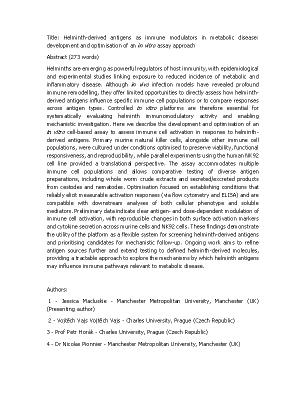
Helminths are emerging as powerful regulators of host immunity, with epidemiological and experimental studies linking exposure to reduced incidence of metabolic and inflammatory disease. Although in vivo infection models have revealed profound immune remodelling, they offer limited opportunities to directly assess how helminth-derived antigens influence specific immune cell populations or to compare responses across antigen types. Controlled in vitro platforms are therefore essential for systematically evaluating helminth immunomodulatory activity and enabling mechanistic investigation. Here we describe the development and optimisation of an in vitro cell-based assay to assess immune cell activation in response to helminth-derived antigens. Primary murine natural killer cells, alongside other immune cell populations, were cultured under conditions optimised to preserve viability, functional responsiveness, and reproducibility, while parallel experiments using the human NK92 cell line provided a translational perspective. The assay accommodates multiple immune cell populations and allows comparative testing of diverse antigen preparations, including whole worm crude extracts and secreted/excreted products from cestodes and nematodes. Optimisation focused on establishing conditions that reliably elicit measurable activation responses (via flow cytometry and ELISA) and are compatible with downstream analyses of both cellular phenotype and soluble mediators. Preliminary data indicate clear antigen- and dose-dependent modulation of immune cell activation, with reproducible changes in both surface activation markers and cytokine secretion across murine cells and NK92 cells. These findings demonstrate the utility of the platform as a flexible system for screening helminth-derived antigens and prioritising candidates for mechanistic follow-up. Ongoing work aims to refine antigen sources further and extend testing to defined helminth-derived molecules, providing a tractable approach to explore the mechanisms by which helminth antigens may influence immune pathways relevant to metabolic disease.