Discussion
Introduction
According to 2024 estimates by WHO, malaria accounts for approximately 282 million cases annually, and tuberculosis (TB) for more than 10 million new cases. Microscopy remains the recognized gold standard of laboratory diagnostics for both diseases. However, conventional microscopy requires highly trained personnel, is time-consuming, poorly reproducible, and insufficiently scalable for population screening needs. We present a compact, affordable, and durable microscopic solution with local AI image analysis, designed for high-throughput field deployment in resource-limited settings.
Methods
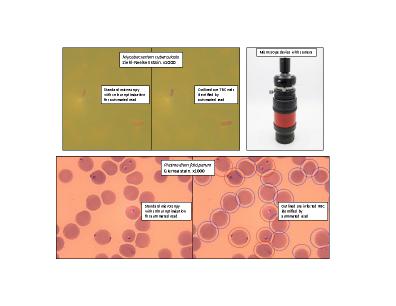
At the core of the system is a patented portable field microscope offering 1000× magnification. The microscope measures 270 × 75 mm, weighs only 1.2 kg, and features a robust tubular body design. A built-in digital camera captures images and transmits them to a standard laptop for processing. To accommodate varying mission requirements, the solution provides three operational modules:
1. Manual sample advancement
2. Microshift (manual step advancement) – currently preferred configuration, optimized for throughput and operational efficiency in field conditions.
3. Automated slide scanning module for autonomous digitization of thin blood smears, currently finishing development
Local AI image analysis is performed by a deep neural network (DNN). The malaria detection model was trained on a dataset of 228,260 annotated images representing four levels of Plasmodium falciparum parasitaemia. The system identifies P. falciparum trophozoites on thin blood smears and provides parasitaemia quantification. Adaptation for TB detection on Ziehl–Neelsen-stained preparations, targeting recognition of acid-fast bacilli, is currently in progress.
Results
The malaria detection model achieved a classification accuracy of 97.88% on the test set. Deployment of 70 field units (each consisting of one microscope and one software license) in a standard 8-hour shift regime enables examination of approximately 1,000,000 persons per year. Real-time data transmission allows immediate sharing of diagnostic results, enabling prompt treatment initiation and continuous epidemiological surveillance.
ConclusionThe presented solution demonstrates the feasibility of deploying digitized microscopy with local AI image analysis at scale in resource-limited field settings. Designed for durability (IP65) and affordability with competitive per-unit manufacturing costs, the system combines a portable microscope, local AI image analysis, and real-time connectivity to address critical barriers to high-throughput malaria and TB screening. The modular architecture enables flexible adaptation from individual diagnostics to population-wide screening in field conditions. Further validation studies are planned, including prospective field trials and completion of the TB detection module.