Authors
B Phipps1; JC Shiau1; JP Flentje1; R Sharma1; AK Pathak1; MR Strand1; 1 University of Georgia, United StatesDiscussion
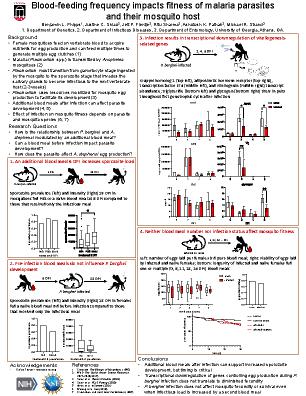
Female mosquitoes blood-feed to acquire nutrients for egg production, often doing so multiple times to produce multiple clutches of eggs. Anopheles mosquitoes transmit malaria parasites, which belong to the genus Plasmodium and kill nearly 500,000 people annually. Despite their virulence to vertebrates, several studies have demonstrated that these parasites impose no fitness cost on their vector. Furthermore, an additional blood meal after infection can accelerate P. falciparum development in A. gambiae, suggesting a second influx of nutrients during Plasmodium development can benefit transmission potential. However, whether the number and timing of blood meals relative to infection shapes the parasite’s development and interaction with the mosquito vector has remained unexplored. This is important for understanding how iterative blood feeding affects malaria transmission potential in nature, since access to vertebrate hosts can vary outside the laboratory. To address this, we offered P. berghei-infected A. stephensi additional naïve blood meals at different frequencies and assessed parasite prevalence and intensity compared to females that received only the infectious meal. We also assessed mosquito fecundity, longevity, expression of vitellogenesis-related genes, and triglyceride and glycogen storage in the fat body relative to naïve females. Sporozoite load increased with blood-feeding frequency, suggesting that malaria-infected mosquitoes that blood-feed more frequently may transmit the parasite more efficiently to their vertebrate hosts. However, while P. berghei modulated gene expression and nutrient mobilization patterns, infection did not affect mosquito fecundity or longevity irrespective of blood meal number, indicating that blood provides sufficient nutrients for non-competitive development of the parasite and its vector.